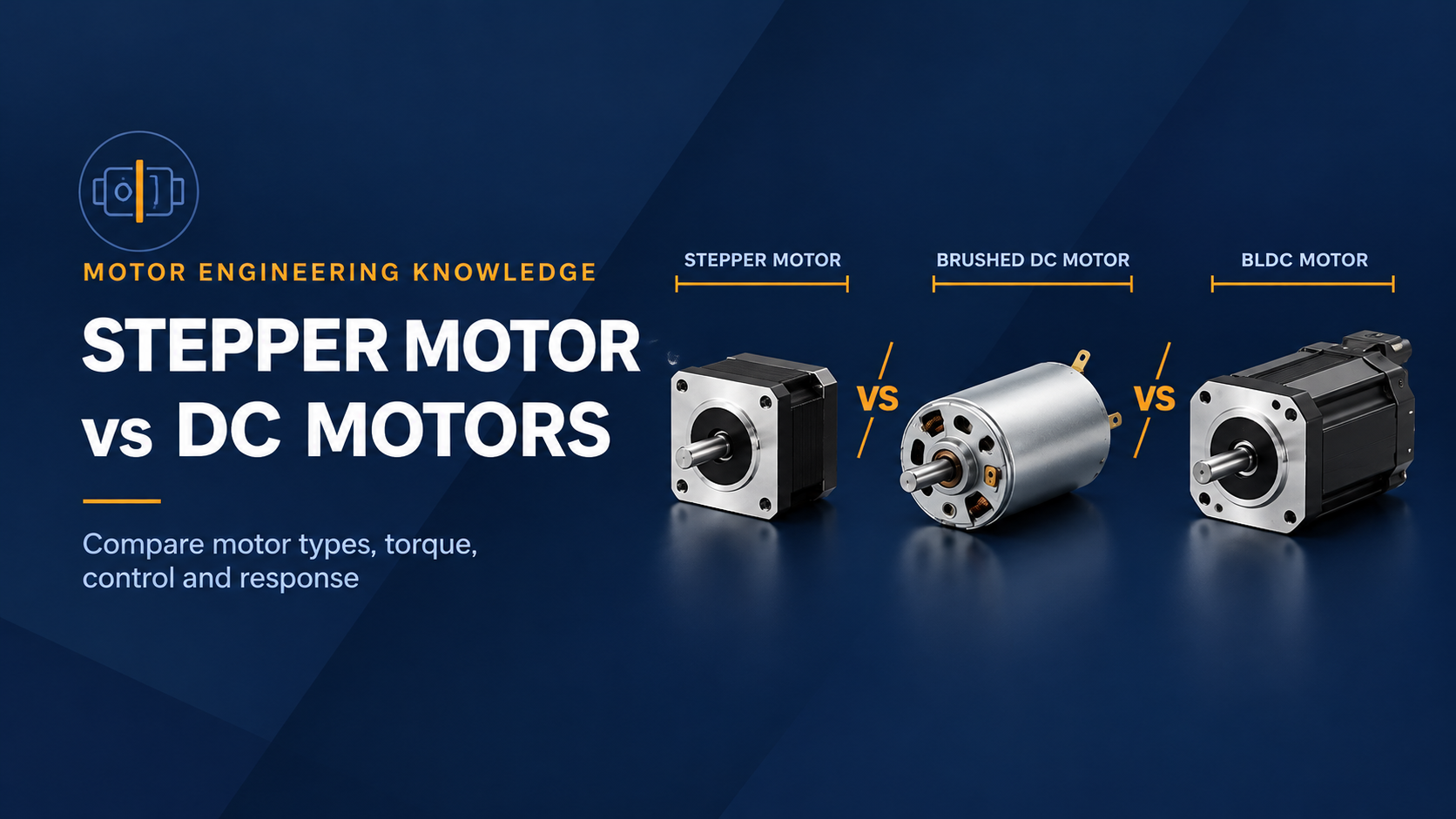
1.Which DC Motors Are Not Stepper Motors?
The distinction isn’t always cut-and-dried. You'll find some sources grouping stepper motors under brushless motors, simply because they don’t use brushes either. In real engineering work, most engineers tell these three motor types apart based on their drive method: steppers run from a stream of pulse signals, BLDC motors rely on rotor-position feedback for commutation, and brushed DC motors just connect straight to a DC power source. For anyone designing products, how these motors are controlled is far more important than what category name you use for them.
2.How Do Stepper, Brushed DC, and BLDC Motors Work?
Stepper Motor
Brushed DC Motor
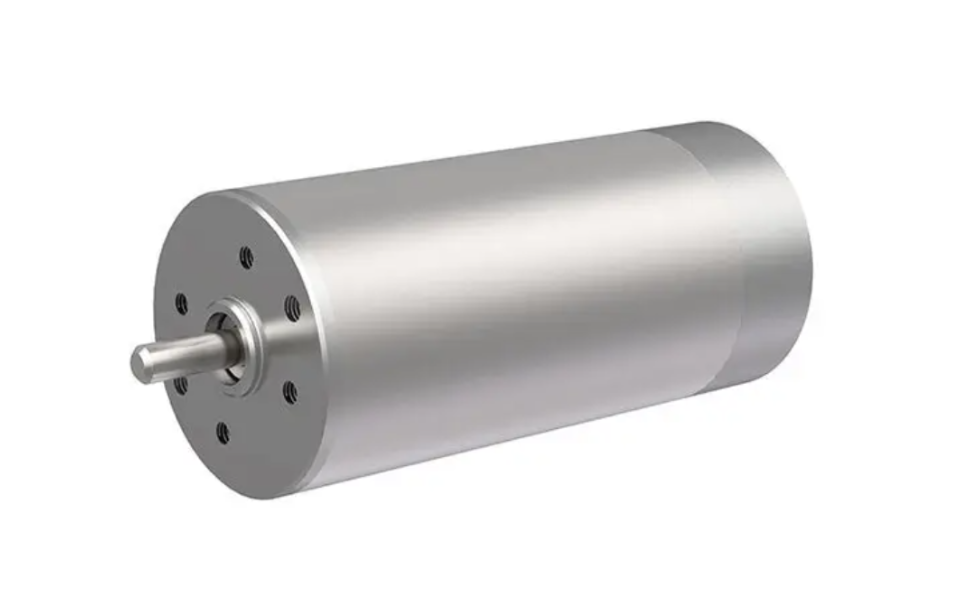
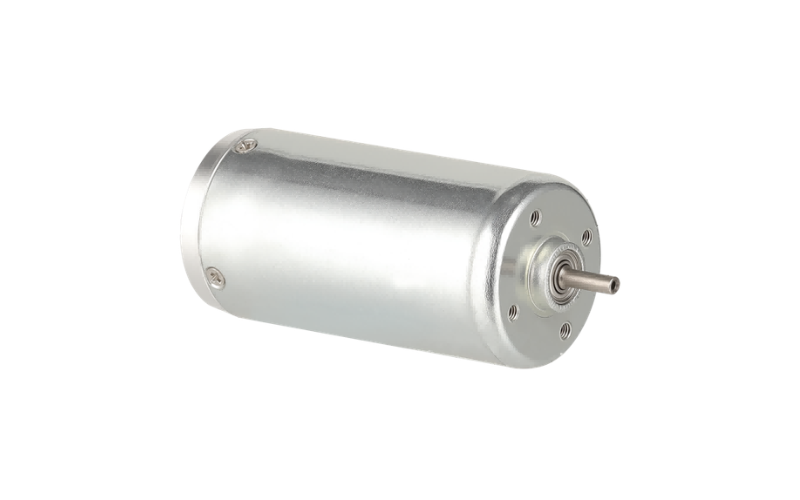
Most brushed DC motors have permanent magnets in the stator, with windings on the rotor. Brushes paired with a mechanical commutator reverse the current flow inside the rotor windings to generate steady torque. Adjusting the input voltage changes motor speed, though the applied load also affects its actual operating speed. The main downside of this design is mechanical wear: because the brushes and commutator touch during operation, they will eventually require servicing or replacement.
BLDC Motor
3.Torque Characteristics: Stepper Motor vs. DC Motor
Stepper motor
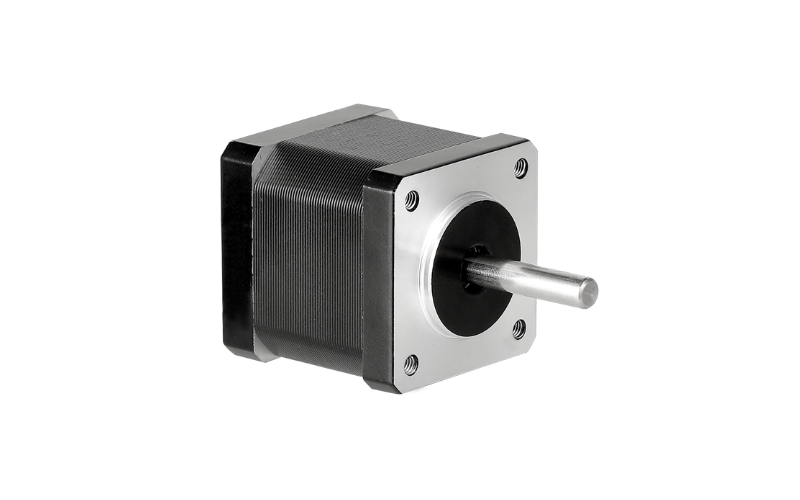
Stepper motors maintain strong holding torque at standstill to lock position. Usable torque falls as speed rises, since winding inductance slows current buildup in the coils. The motor will skip steps if the load exceeds its torque capacity.
Our AW60HS geared stepper motor uses a precision planetary gearbox to boost torque and lower output speed. This works when a standard 60mm frame stepper cannot meet load torque demands. Designers should plan for gear backlash — typically 10–20 arc‑min for single‑stage planetary units — and reduced speed from the gear ratio.
Brushed DC motor
With brushed DC motors, you get strong starting torque right off the bat — just how strong depends on the motor’s physical design and its current rating. Torque output tracks closely with armature current, while running speed is mostly set by your supply voltage and the load on the shaft. Keep the voltage fixed, and available torque will drop as you increase speed. These are a solid pick for continuous-rotation work that needs simple speed control and dependable startup, without the cost and complexity of a full servo system.
BLDC motor
BLDC motors stand out for their wide operating speed range and high torque density relative to their frame size. Pair one with a properly matched driver, and it delivers smooth, regulated torque up to its rated speed. Above that threshold, it can run in constant-power mode — as long as you stay within the motor’s safe operating limits.
4.Control Precision: Which Motor Is More Accurate?
Stepper motors
Stepper motors are a go-to choice for positioning tasks because every input pulse translates directly to a set angular increment on the output shaft. Microstepping splits each full step into far smaller increments, and it does smooth out low-speed motion noticeably. But finer electrical resolution doesn’t automatically translate to a proportional boost in real mechanical accuracy. Real-world variables — applied load, friction, manufacturing tolerances, and skipped steps — all push the final position off its intended target.
Brushed DC motors
With a conventional brushed DC motor, you tune speed by adjusting the supply voltage — but voltage on its own can't hold the shaft at a fixed position. For reliable positional control, you'll need to add an encoder and a closed-loop controller.
BLDC motors
A BLDC motor works in either open-loop or closed-loop setups. Pair it with an encoder and a servo drive, and it can deliver tight, precise control over position, speed, and torque. How well it actually performs comes down to a handful of factors: encoder resolution, controller capability, mechanical stiffness of the drivetrain, and how well the whole system is tuned.
5.Response Speed: How Quickly Can Each Motor React?
Stepper motors need a suitable acceleration profile. If speed or acceleration rises too quickly, the rotor may fall out of sync with the pulses. Smooth acceleration and deceleration reduce vibration and the risk of lost steps.
At the end of the day, response speed is never determined by motor type on its own. You have to evaluate the full drive system as a whole. For applications with frequent speed shifts or demanding duty cycles, compare inertia values, torque-speed curves, and controller performance directly — don't just judge by which motor category it falls into.
6. Stepper Motor vs. Brushed DC Motor vs. BLDC Motor
Feature | Stepper Motor | Brushed DC Motor | BLDC Motor |
| Operating principle | Incremental movement through controlled phase excitation | Mechanical commutation with brushes | Electronic commutation |
| Typical focus | Positioning and indexing | Continuous rotation and speed control | Continuous rotation, speed control and servo motion |
| Holding torque at standstill | Available when energized | Depends on motor and control system | Depends on motor and control system |
| Position control | Often pulse-based and open loop | Needs suitable feedback for precise positioning | Encoder feedback supports precise positioning |
| Maintenance | No brushes in typical hybrid designs | Brushes and commutator can wear | No mechanical brushes |
| Dynamic response | Depends on load, speed and acceleration profile | Depends on motor and drive | Can be fast with a suitable drive and control loop |
| Main selection factor | Positioning need and torque margin | Simple continuous rotation and starting performance | Speed range, power density and dynamic control |
7.How to Choose the Right Motor for Your Application
Choose a stepper motor for controlled incremental movement, repeatable positioning or indexing, when it can provide enough torque across the operating speed range.
Choose a brushed DC motor when the application mainly needs continuous rotation and simple speed control, and you can plan for brush wear and maintenance.
Choose a BLDC motor when you want brushless operation, a broad speed range or strong dynamic performance. If accurate position or speed regulation is required, evaluate a motor and driver pair with suitable feedback.
Conclusion
Motor Engineering Knowledge Published October 21, 2026 · 6 min read · By Apexwell Engineering Team