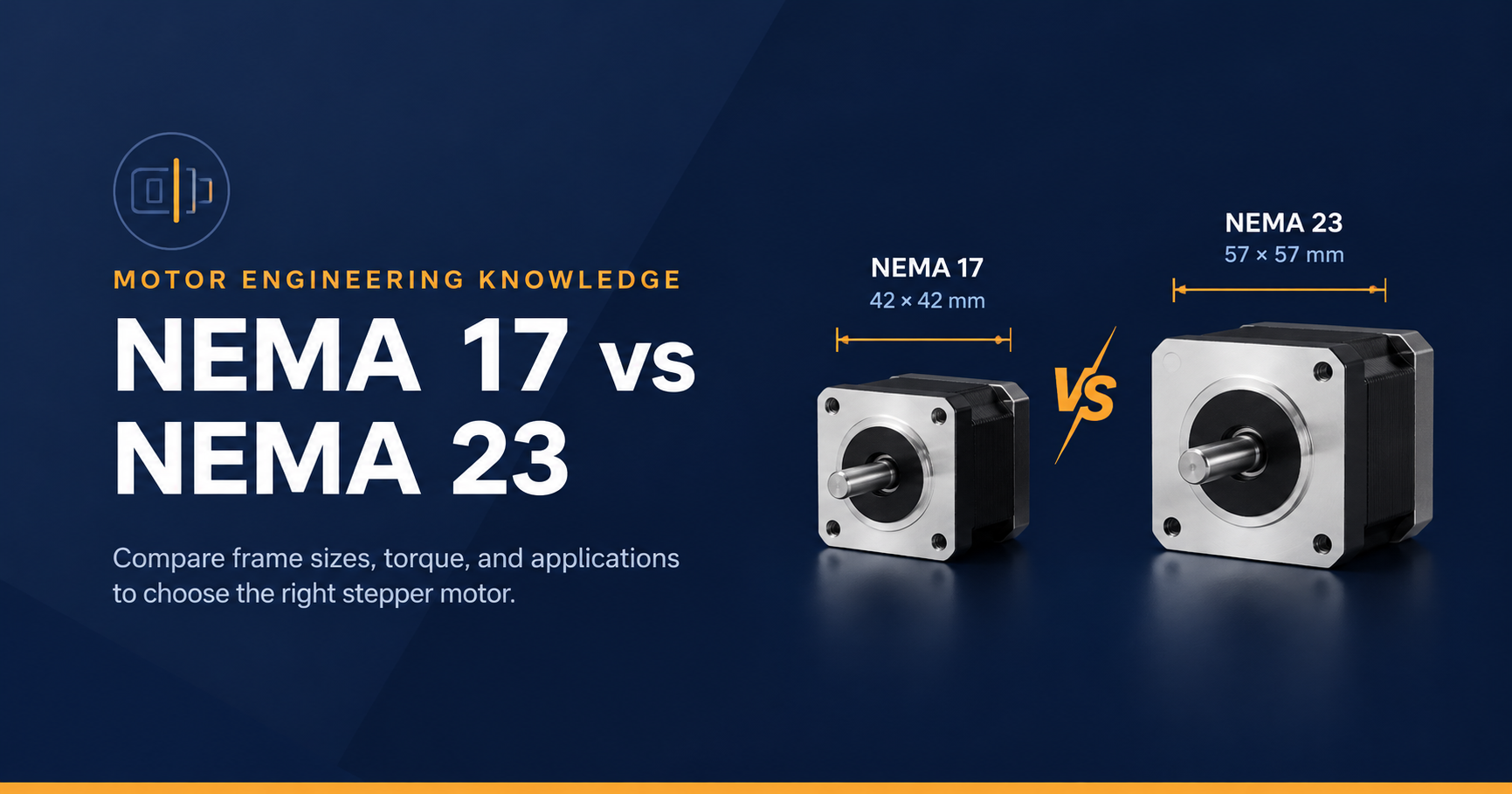
NEMA 17 and NEMA 23 are two commonly used frame sizes for hybrid stepper motors. The main difference is their mounting dimensions: a NEMA 17 stepper motor typically has a 42 × 42 mm mounting face, while a NEMA 23 stepper motor typically has a 57 × 57 mm mounting face. NEMA 23 motors generally offer higher holding torque options, making them suitable for applications with greater torque requirements. NEMA 17 motors are often selected for more compact equipment where installation space and moderate torque are important.
However, a larger frame size does not automatically guarantee better performance in every application. Motor length, winding parameters, phase current, supply voltage, driver configuration, operating speed, and load conditions all affect the actual torque output. To choose between a stepper motor NEMA 17 and a stepper motor NEMA 23, it is important to compare the complete specifications rather than the frame size alone.
NEMA 17 vs NEMA 23: Main Differences
The NEMA designation identifies a motor's standardized mounting frame dimensions. It does not directly specify holding torque, maximum speed, or power consumption.
In Apexwell's hybrid stepper motor range, the AW42HS series corresponds to NEMA 17, with a 42 mm frame, while the AW57HS series corresponds to NEMA 23, with a 57 mm frame. The product catalog lists the following specifications:
| Specification | NEMA 17 | NEMA 23 |
|---|---|---|
| Apexwell series | AW42HS | AW57HS |
| Frame size | 42 mm | 57 mm |
| Motor body length | 20–60 mm | 41–112 mm |
| Phase current range | 1.0–1.7 A | 2.0–4.2 A |
| Holding torque range | 0.13–0.75 N·m | 0.55–2.5 N·m |
| Typical selection priority | Compact size and moderate torque | Higher torque options and larger mounting space |
Specifications are based on Apexwell's current hybrid stepper motor catalog. The ranges cover multiple models, not a direct comparison between every motor in the two series.
As the table shows, the NEMA 23 series provides higher holding torque options in Apexwell's catalog. However, the actual motor should be selected according to the required torque at the intended operating speed, not holding torque alone.
NEMA 17 Stepper Motor
A NEMA 17 stepper motor has a nominal mounting face of approximately 42 × 42 mm. Its compact size makes it a practical choice for equipment where mounting space, motor weight, and controlled positioning need to be balanced.
Apexwell's AW42HS hybrid stepper motor series includes body lengths from 20 mm to 60 mm, with holding torque ranging from 0.13 N·m to 0.75 N·m and phase current from 1.0 A to 1.7 A. This range provides different options for compact motion-control systems.
A NEMA 17 motor may be suitable for:
Compact automation equipment
Laboratory and medical instruments
Small positioning mechanisms
Feeders and indexing systems
Camera and optical mechanisms
OEM equipment with limited installation space
The torque available during motion depends on speed, supply voltage, driver settings, and the motor's winding characteristics. Before selecting a NEMA 17, check the torque-speed curve and confirm that the motor can meet the required load and acceleration.
NEMA 23 Stepper Motor
A NEMA 23 stepper motor has a nominal mounting face of approximately 57 × 57 mm. Compared with NEMA 17, this frame size offers a broader range of higher-torque configurations in Apexwell's current hybrid stepper motor catalog.
The Apexwell AW57HS series has body lengths from 41 mm to 112 mm, phase current ratings from 2.0 A to 4.2 A, and holding torque ratings from 0.55 N·m to 2.5 N·m. Different body lengths and winding specifications allow the motor to be matched to different motion requirements.
A NEMA 23 stepper motor may be considered for:
CNC routers and positioning axes
Industrial automation machinery
Packaging and indexing equipment
Robotic mechanisms
Linear motion systems
OEM equipment requiring higher torque options
The larger mounting face and available torque range can make NEMA 23 a suitable choice for applications that exceed the practical capacity of a particular NEMA 17 model. Nevertheless, motor selection should account for the actual operating point, acceleration profile, load inertia, and mechanical transmission.
For applications requiring a specific shaft interface or additional mechanical components, Apexwell supports options such as encoders, pulleys, planetary gearboxes, and eccentric gearboxes, depending on the motor series and configuration.
NEMA 17 vs NEMA 23: Which One Should You Choose?
The choice between a NEMA 17 and a NEMA 23 depends on the equipment's load, motion profile, and available installation space.
Choose a NEMA 17 stepper motor when the machine requires a compact motor and the available torque meets the application's needs. It can help reduce the motor's physical footprint and may simplify integration into smaller equipment.
Choose a NEMA 23 stepper motor when the application requires a higher holding-torque option or when the selected NEMA 17 model cannot provide sufficient torque at the required speed. The larger frame also requires more mounting space and may involve a different mounting pattern, shaft interface, and driver-current requirement.
Before making a final decision, compare:
Required torque at the operating speed
Acceleration and deceleration requirements
Load inertia and mechanical friction
Motor body length and installation space
Shaft diameter and mounting dimensions
Phase current and driver compatibility
Supply voltage and duty cycle
Holding torque is useful for comparing motor specifications, but it does not represent the torque available at every operating speed. Review the manufacturer's torque-speed curve under the relevant drive conditions before finalizing the selection.
What About a NEMA 24 Stepper Motor?
A NEMA 24 stepper motor is another option when the application needs a different mounting size and torque range. In Apexwell's hybrid stepper motor catalog, the AW60HS series uses a 60 mm frame and has body lengths from 56 mm to 100 mm. Its listed holding torque range is 1.25–2.8 N·m, with phase current from 2.8 A to 4.2 A.
This makes NEMA 24 worth considering when comparing motor dimensions and torque requirements across nearby frame sizes. Its mounting face is larger than NEMA 17 and slightly larger than NEMA 23, but frame size alone does not establish that it is the best option for a given application.
When comparing a NEMA 24 stepper motor with NEMA 17 or NEMA 23, check the complete mechanical drawing, shaft dimensions, body length, current rating, torque-speed curve, and compatibility with the selected driver.
Does a Longer Stepper Motor Produce More Torque?
Within the same motor series, a longer body often provides room for a different electromagnetic design and may offer higher holding torque. Apexwell's AW42HS and AW57HS catalogs show multiple body lengths and torque ratings within each frame size.
For example, the AW42HS series has listed holding torque values from 0.13 N·m to 0.75 N·m, while the AW57HS series ranges from 0.55 N·m to 2.5 N·m. These ranges demonstrate why it is important to compare individual models rather than treating all motors with the same NEMA designation as identical.
Motor length alone, however, is not enough to predict performance. Winding resistance, inductance, phase current, supply voltage, and operating speed also affect the available torque. For moving applications, the torque-speed curve is more informative than holding torque alone.
Shaft loading is another consideration. Axial and radial loads should remain within the limits specified for the selected motor. Proper mounting and shaft alignment help prevent unnecessary mechanical stress during operation.
Can Apexwell Customize NEMA 17 and NEMA 23 Stepper Motors?
Standard catalog specifications may not always match the mechanical or electrical requirements of an OEM machine. Depending on the motor series, Apexwell can support application-specific configurations involving winding parameters, output shaft dimensions, connectors, encoders, pulleys, and gearboxes.
When requesting a NEMA 17 or NEMA 23 stepper motor for an OEM project, provide the required torque, operating speed, supply voltage, installation space, shaft dimensions, control method, and feedback requirements. These details help determine whether a standard model is suitable or whether a customized configuration should be considered.
Explore Apexwell's hybrid stepper motor range to compare available frame sizes and configurations. If you need help choosing a motor for your equipment, contact Apexwell with your application requirements.