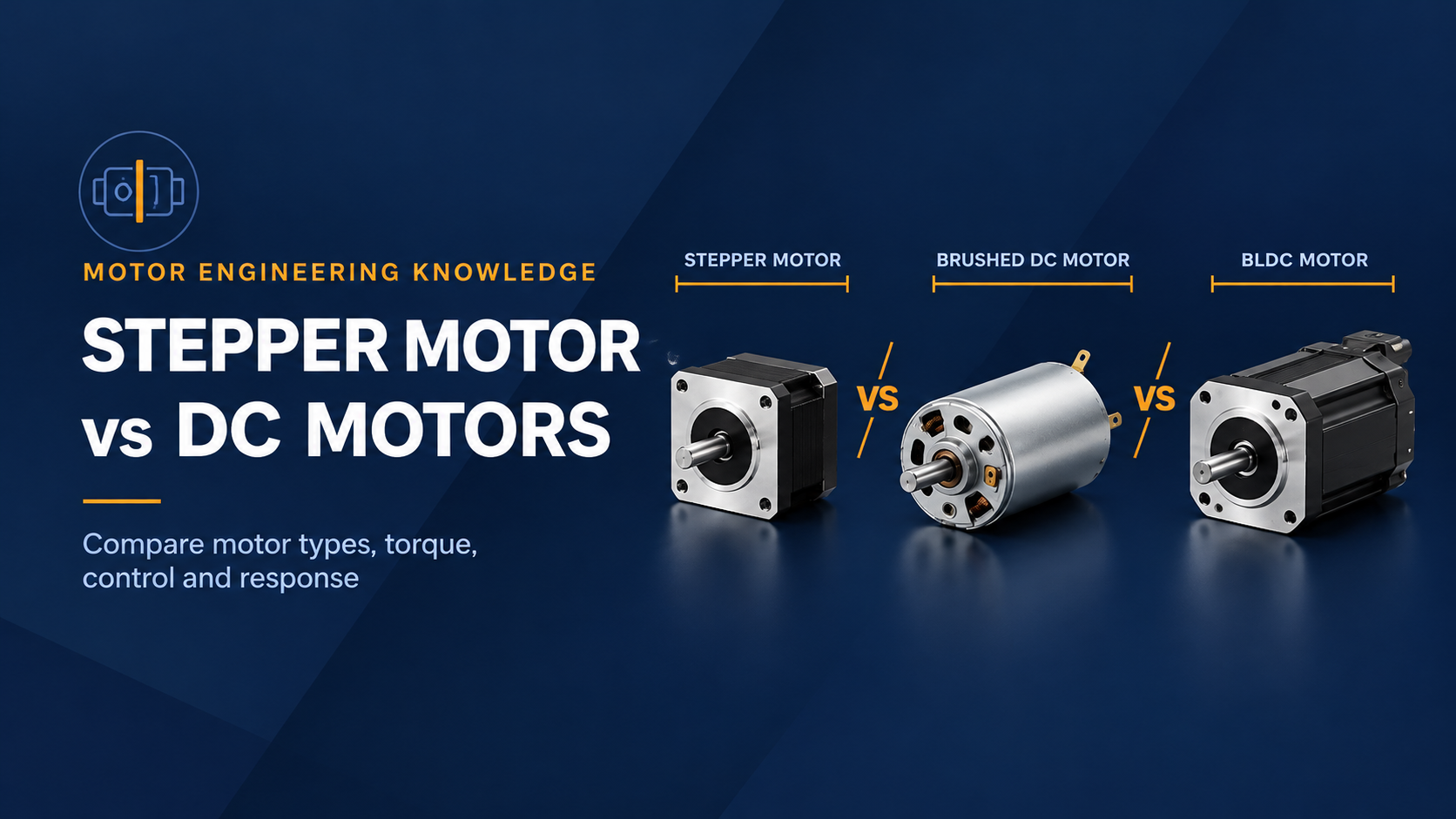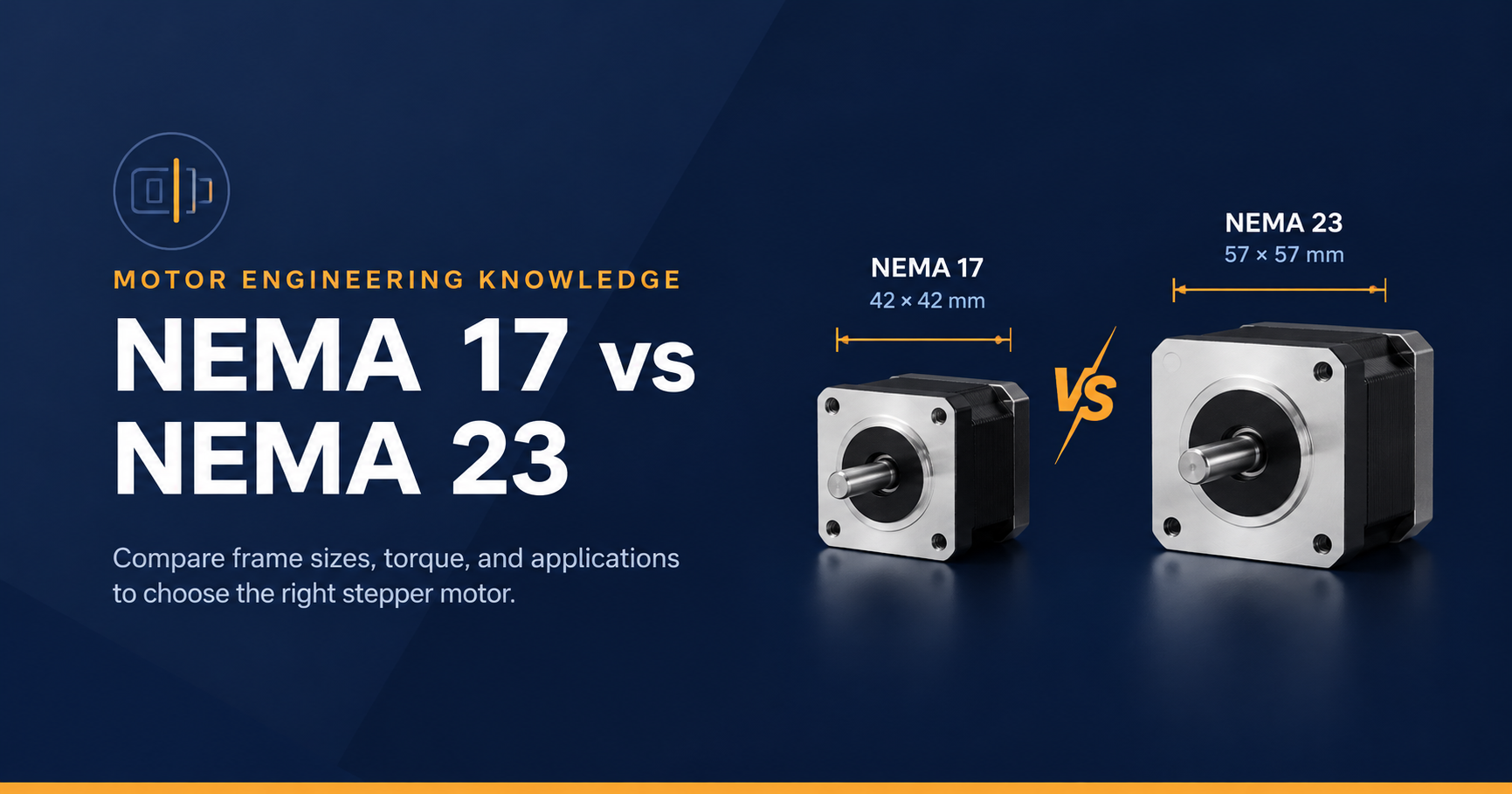
A plain-language introduction to stepper motor construction, driving modes, and types — with a comparison table for engineers evaluating their first design.
Motor Engineering Knowledge Published Sep 4, 2026 · 8 mins read · By Apexwell Engineering Team
A stepper motor is a brushless DC motor that converts electrical pulses into fixed, incremental steps of rotation, allowing precise positioning without a feedback sensor. It is one of the most widely used motion-control components in automation, robotics, and instrumentation.
How does a stepper motor work?
Inside a stepper motor, a permanent-magnet rotor sits surrounded by multiple sets of stator windings. When a driver energizes these windings in a specific sequence, each set generates a magnetic pole that attracts or repels the rotor, pulling it into alignment one step at a time[1]. Because the number of poles on the rotor and stator is deliberately mismatched, the rotor can only settle into one predictable position for each energized winding set — which is what keeps the motion direction consistent and repeatable rather than random[2].
Since each pulse from the driver corresponds to a fixed angle of rotation, a stepper motor can be positioned accurately simply by counting pulses, with no need for an encoder or other feedback device in most standard applications.
What are the main stepper motor driving modes?
A stepper motor driver can energize the windings in several ways, and the mode selected directly affects both resolution and torque[3]:
| Driving Mode | Steps per Revolution | Step Angle | Trade-off |
|---|---|---|---|
| Full Step | 200 | 1.8° | Highest torque per step, coarser resolution |
| Half Step | 400 | 0.9° | Finer resolution, some torque reduction |
| Microstepping (1/16) | 3,200 | 0.1125° | Smooth, quiet motion for precision positioning |
| Microstepping (1/256) | 51,200 | ~0.007° | Maximum resolution, used in high-precision robotics |
Higher microstepping ratios reduce vibration and audible noise, which is one reason closed loop and microstepping drivers have become standard in applications like robotic joints and laboratory instruments.
What are the three main types of stepper motors?
Permanent magnet (PM) stepper motors use a magnetized rotor with alternating north/south poles. They are simple and low-cost but offer coarser step angles, typically 7.5° to 15°.
Variable reluctance (VR) stepper motors use a toothed soft-iron rotor with no permanent magnet, moving to the position of minimum magnetic reluctance. They offer fast response but lower holding torque without power applied.
Hybrid stepper motors combine both principles — a magnetized, toothed rotor — to deliver the fine step resolution of a VR motor with the higher torque of a PM motor. Most industrial and OEM stepper motors in use today, including Apexwell's NEMA 8 to NEMA 42 range, are hybrid stepper motors.
Open loop vs. closed loop stepper motors
A standard hybrid stepper motor runs open loop: the driver sends pulses and assumes the rotor followed them exactly. This works reliably as long as the load never exceeds the motor's available torque at a given speed. If it does, the rotor can fail to keep up with the pulses — a condition known as step loss or a stall.
A closed loop stepper motor adds an encoder to the shaft, allowing the driver to confirm actual rotor position and automatically correct for any missed steps. This adds cost but removes the risk of silent positioning errors, which matters most in applications like packaging equipment, robotics, and medical devices where a missed step is not an option.
Apexwell manufactures hybrid stepper motors from NEMA 8 to NEMA 42, in both open loop and closed loop configurations, with custom torque, shaft, and connector options. See the full stepper motor range or explore our compact AW20HS NEMA 8 stepper motor.
Where are stepper motors used?
Because of their precise, repeatable positioning and simple open-loop control, stepper motors are widely specified into 3D printers, CNC machines, robotics joints, camera and lens focus mechanisms, medical infusion pumps, and solar tracking systems, among many other motion-control applications.
Frequently Asked Questions
Is a stepper motor AC or DC?
A stepper motor runs on DC power and is technically a type of brushless DC motor. Its driver switches current through the winding phases in sequence, which is why some references describe its behavior as similar to an AC machine.
Do stepper motors need a driver?
Yes. A stepper motor cannot run directly from a DC power supply — it requires a dedicated driver to energize the winding phases in the correct sequence and, in most designs, to regulate current for consistent torque.
What is the difference between a stepper motor and a servo motor?
A standard stepper motor operates open loop, moving a fixed number of degrees per pulse with no position feedback. A servo motor uses an encoder to continuously correct its position and speed, which typically gives it higher speed and better performance under variable load.
Can a stepper motor lose steps?
Yes. If load torque exceeds the motor's available torque at a given speed, the rotor can fail to keep pace with the driving pulses — a condition known as step loss. Closed loop stepper motors add encoder feedback specifically to detect and correct this.
Sources & Further Reading
How a Stepper Motor Works — HowToMechatronics: howtomechatronics.com
What Is a Stepper Motor, and How Does It Work? — control.com Technical Articles: control.com
Stepper Motor Working Principle — GlobalSpec: globalspec.com
Everything You Need to Know About Stepper Motors — RS Components: rs-online.com
How a Stepper Motor Works — Nanotec Knowledge Base: nanotec.com