
Previous
Next
DM860H — 2-Phase Digital Stepper Driver with Serial Debugging
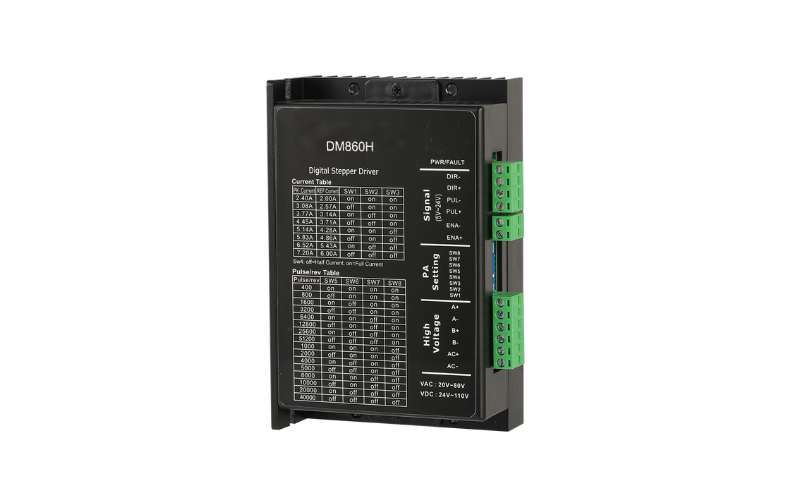
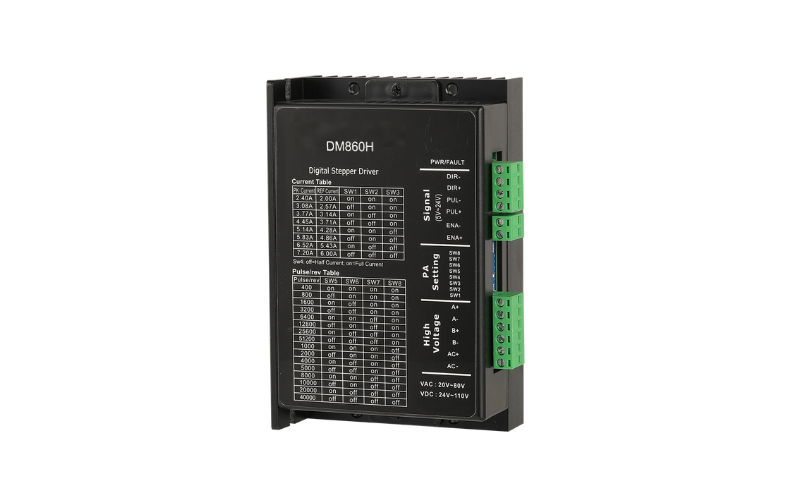
The DM860H is a two-phase digital stepper driver with serial-port debugging, built on the latest 32-bit DSP control technology and integrating the MODBUS-RTU standard protocol. Using host-computer configuration software, users can set microstepping anywhere from 200 to 40,000 steps/rev along with operating mode and other parameters — a level of software configurability the DM422 and DM556 don't offer. Like Apexwell's other digital stepper drivers, it uses servo-like vector control, built-in microstepping, and adaptive filtering for smooth, quiet operation at low, medium, and high speeds, with pure sine-wave current control that reduces motor heating. Its operating range — AC20–80V (DC30–110V) input, up to 7.2A peak current — is sized for 57mm to 110mm-frame two-phase hybrid stepper motors, the widest motor range and highest current of Apexwell's DM-series digital drivers.
Features
Serial-port debugging capability
Compact, easy-to-mount enclosure
Opto-isolated differential signal inputs
Microstepping configurable from 200 to 40,000 steps/rev
Freely configurable output current
Overvoltage, undervoltage, and overcurrent protection
32-bit DSP control technology
Drives 4-, 6-, or 8-wire two-phase stepper motors
Built-in microstepping
Pulse response frequency up to 200 kHz (higher available on request)
Precision current control significantly reduces motor heating
Automatic idle-current reduction when stationary
Electrical Specifications
| Parameter | Min | Typical | Max | Unit |
|---|---|---|---|---|
| Output Current | 2.4 | — | 7.2 | A |
| Input Supply Voltage | 20 | 60 | 80 | VDC |
| Control Signal Input Current | 7 | 10 | 16 | mA |
| Step Pulse Frequency | 0 | — | 200 | kHz |
| Insulation Resistance | 50 | — | — | MΩ |
Environmental Specifications
| Parameter | Value |
|---|---|
| Cooling | Natural convection or fan-assisted |
| Operating Temperature | 0°C to 50°C |
| Storage Temperature | -20°C to 65°C |
| Humidity | 40–90% RH |
| Vibration | 10–55 Hz / 0.15 mm |
| Installation Environment | Keep away from other heat-generating equipment; avoid dust, oil mist, corrosive gas, high humidity, strong vibration; no flammable gas or conductive dust |
Control Signal Interface
| Pin | Function |
|---|---|
| PLS+ / PLS- | Pulse input. Drivable at +5V to +24V, active on rising edge — the motor advances one microstep on each falling edge of the pulse. Pulse width should exceed 2μs for reliable response. |
| DIR+ / DIR- | Direction input. Drivable at +5V to +24V, high/low level signal. The direction signal should be established at least 5μs before the pulse signal to guarantee reliable direction changes. Initial rotation direction depends on motor wiring; swapping either phase winding (e.g., A+/A-) reverses it. |
| ENA+ / ENA- | Enable input. Drivable at +5V to +24V, high/low level signal. Pulling ENA+ to +5V and ENA- low cuts current to all motor phases, putting the motor in a free (unpowered) state and ignoring step pulses. Leave the enable input floating when this function isn't needed. |
Power Interface
| Pin | Function |
|---|---|
| AC1 / AC2 | AC input power, AC20–80V (DC30–110V) |
| A+ / A- | Motor phase A winding |
| B+ / B- | Motor phase B winding |
RS232 Communication Interface
The DM860H's serial interface uses a white PH2.0-7P terminal, connected to a PC via a dedicated serial cable through a USB-to-TTL converter. Do not connect or disconnect the cable while powered. From the PC side, users can configure current, microstepping, operating mode, and other parameters through the host-computer software interface.
| Terminal | Symbol | Name | Description |
|---|---|---|---|
| 1 | NC | — | Internal use |
| 2 | NC | — | Internal use |
| 3 | GND | RS232 communication ground | 0V |
| 4 | NC | — | Internal use |
| 5 | NC | — | Internal use |
| 6 | TXD | RS232 transmit | — |
| 7 | RXD | RS232 receive | — |
Typical Applications
Sized for 57mm to 110mm two-phase hybrid stepper motors up to 7.2A peak current, with software-configurable microstepping and current settings, the DM860H fits industrial CNC and machine tool axes, textile and printing equipment, packaging machinery, and other mid-to-heavy-duty applications where field-tunable driver parameters and AC-voltage input are useful.
Why Choose the DM860H
Serial-port debugging and MODBUS-RTU support let engineers set microstepping anywhere from 200 to 40,000 steps/rev and freely configure output current from a PC, instead of relying on fixed DIP-switch settings — useful for tuning a single driver design across multiple motor sizes or matching a customer's specific resolution requirement. The 32-bit DSP core with vector control and pure sine-wave current drive keeps the motor running smoothly across its full speed range while cutting the heat buildup that plain constant-current drivers produce, and built-in microstepping and adaptive filtering reduce resonance-related noise and vibration without external tuning. AC20–80V input accepts either AC or rectified DC supply, and built-in overvoltage, undervoltage, and overcurrent protection add a layer of safety for the higher current levels this driver is built to handle.
We can customize the driver's electrical parameters and mechanical configuration according to customer requirements. For more product information, please visit our company website.